When the world ended, love didn’t. It just got quieter.
The first time I saw Eli, he was standing in the ruins of a supermarket holding a can of peaches like it was treasure.
I was pointing a knife at his throat.
He raised his hands slowly. “Hey, I’m not infected.”
I tightened my grip. “Everyone says that.”
He smiled, tired but somehow still charming. “Then maybe I’m the last honest liar.”
“Put the peaches down,” I said.
He set them on the floor carefully. “Can we share them? I haven’t had fruit since… civilization.”
I hesitated. He didn’t look dangerous. More like someone who’d run out of people to talk to.
So I lowered the knife. “Fine. Half.”
He grinned. “You’re generous.”
I snorted. “You’re alive because of it.”
That’s how it started. A truce made over canned peaches.
We travelled together because loneliness was worse than fear.
He could fix radios; I could kill quietly. It worked.
The nights were the hardest. The air smelled like smoke and rot, and the world felt like a ghost. Sometimes he’d hum while cleaning his knife.
“What are you humming?” I asked one night.
“‘Here Comes the Sun.’”
“There hasn’t been sun in months.”
“Still helps to pretend.”
“Pretending gets you killed.”
He looked up. “So does giving up.”
I didn’t answer. I never did when he said things that made me feel too much.
We camped in abandoned houses. Broken windows, creaking floors. I always took first watch.
One night, he woke up early and sat beside me. “You never sleep,” he said.
“Someone has to keep us alive.”
“You don’t have to do it alone.”
“I’m used to alone.”
He smiled softly. “You shouldn’t be.”
“Why not?”
“Because the world’s already trying to kill us. We shouldn’t help it.”
I didn’t look at him. “You talk too much for an apocalypse.”
“And you listen too little for someone who misses it,” he said.
That was Eli — annoying, kind, impossible not to like.
Weeks passed. The days blurred.
One evening, we sat on the roof of an old gas station watching the gray horizon.

“If we were normal,” he said, “I’d take you to a movie.”
“Zombies killed Netflix,” I replied.
“Then I’d take you dancing.”
“There’s no music.”
He looked at me. “Then I’d hum something.”
“You’re ridiculous.”
He grinned. “Admit it. You’d dance with me.”
I tried to hide my smile. “Maybe.”
He offered his hand, mock serious. “Then practice for when the world’s fixed.”
I shook my head but took his hand anyway. We swayed on the rooftop — no rhythm, no sound, just wind and heartbeat. For a few seconds, the world didn’t feel so broken.
We found the radio two weeks later. An old hand-cranked thing in a convenience store basement. He fixed it using copper wire and a bit of luck.
And then, through the static:
“Safe Zone. South Haven. Coordinates… repeat, South Haven.”
Eli’s eyes lit up. “It’s real, Nina. We can make it.”
I froze. “Or it’s bait.”
“Or it’s home.”
“Home’s gone.”
“Then we’ll build one.”
I shook my head. “You can’t keep saving everyone, Eli.”
“I’m not trying to save everyone.”
“Then who?”
He looked straight at me. “You.”
I wanted to tell him not to. That love was a luxury we couldn’t afford. But the words wouldn’t come.
We set out the next morning. The sky was heavy, the roads cracked.
“Do you think there’s anyone left who still kisses just because?” he asked suddenly.
“What?”
“You know — no reason. Just because it feels good.”
I gave him a look. “You’re unbelievable.”
“Hey, I’m asking for science.”
“You’ll die before we reach South Haven if you keep talking like that.”
He smirked. “Worth it.”
That night, the world caught up with us.
We were making camp near the woods when the moaning started — low, wet, close. The horde had found us.
“Run,” I hissed.
Eli grabbed his pack. “Go! I’ll hold them off!”
“Don’t you dare—”
But he was already swinging his machete.
I fought beside him, blades flashing in the dark. For every one we took down, two more came. When the noise finally stopped, everything was still.
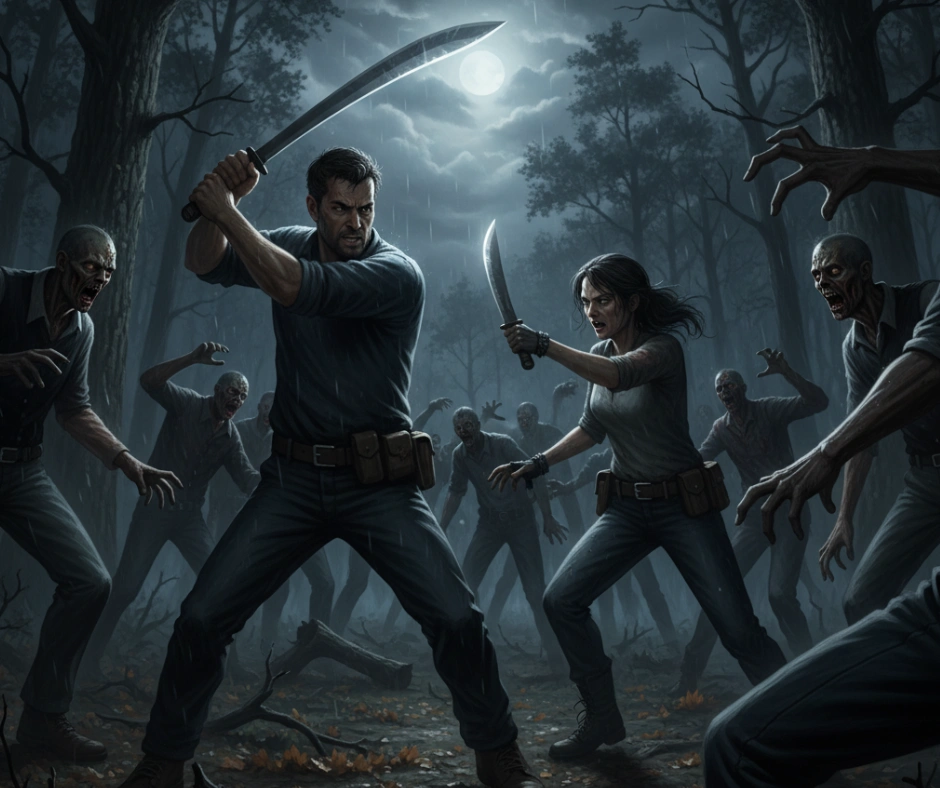
And Eli was on the ground.
Blood soaked his shirt.
“Eli,” I whispered. “No, no, no…”
He smiled weakly. “Guess the liar finally got infected.”
“Don’t— don’t say that.”
He winced. “It’s okay. I’ve had worse.”
“Liar.”
He chuckled, coughing. “See? Honest liar.”
I pressed my hand to his wound. “You can’t leave me.”
“Can’t promise that.”
“You promised peaches, dancing, stupid jokes—”
He reached up, brushed my cheek. “You made me human again, Nina. That’s more than most people get.”
Tears blurred everything. “I can’t lose you.”
“You won’t.”
“How?”
“When you look at the stars… the ones you swear aren’t there, I’ll be one of them.”
I laughed through the tears. “You’re not allowed to be poetic right now.”
“Then you be poetic for both of us.”
I couldn’t. So I kissed him instead. Slow. Desperate. The kind of kiss that means I’m sorry, I love you, please don’t go.
When I pulled back, his eyes were still open, but the world inside them was gone.
Morning came gray and silent. I buried him under a birch tree, wrapped in the only clean blanket we had left. I placed the radio beside him.
“Someone should still get to hear your voice,” I whispered.
Then I pressed my hand to the dirt. “You win, Eli. I’ll find the stars.”
I walked south alone.
Weeks later, the radio crackled in my pack.
“South Haven calling. Survivors found near the coast… coordinates repeat…”
And for a moment. Just a heartbeat. I could swear I heard someone humming Here Comes the Sun beneath the static.


