The first time Aria met Lucien Vale, it was 12:03 a.m.
She almost turned around at the sight of the penthouse. All glass, gold, and silence.
He opened the door himself. “Miss Lorne,” he said, voice deep enough to vibrate through her chest. “You’re punctual.”
“It’s midnight,” she said. “That’s not punctual, that’s insane.”
Lucien smiled faintly. “I work best when the city sleeps.”
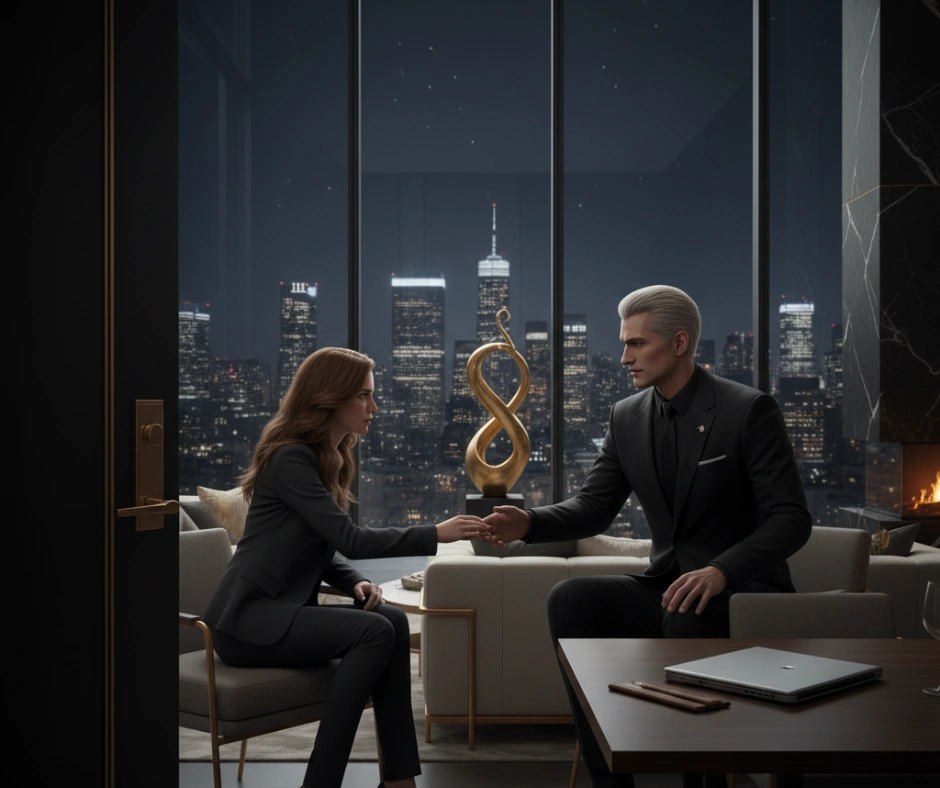
Aria set down her laptop on the table. The view outside showed a skyline glittering like frost. She’d been hired to ghostwrite his memoir. The untold life of a man who made a fortune in biotech and refused all interviews.
“Coffee?” he offered.
“It’s past midnight.”
“Then wine.”
“I have a deadline,” she countered.
He poured her a glass anyway. The liquid was a dark, opaque red.
She lifted it, suspicious. “Please tell me this isn’t… blood.”
His smile didn’t reach his eyes. “Would it matter?”
“It would make me a witness,” she said, and took a sip. It was just wine. Probably.
They started meeting every night. Lucien never scheduled sessions before sunset. His apartment was always cold, though the fireplace never went out.
He told stories. Not about mergers or billion-dollar deals, but about wars, plagues, empires.
“You talk like you were there,” Aria said once.
“I was,” he replied, too softly.
She laughed. “Right. So what, you’re a time-traveler now?”
“Something like that.”
There was a pause. His eyes. An impossible silver-gray, stayed on her pulse.
“Don’t do that,” she murmured.
“Do what?”
“Stare at my neck like you’re… hungry.”
He looked away, jaw tightening. “Apologies. Old habits.”
By their fifth session, the boundaries had blurred. She brought her laptop, but the conversation wandered.
“Why me?” she asked one night. “You could hire any writer in the world.”
“I tried,” he said. “They all wanted to tell a legend. You listen like you want to tell the truth.”
“What truth?”
“That I’m not what I pretend to be.”
She leaned back in her chair. “So who are you, Mr. Vale?”
He met her gaze. “Someone who stopped dying a long time ago.”
She laughed again, but it came out shaky. “You’re joking.”
He didn’t answer. The silence stretched until she could hear her own heartbeat.
After that, she started noticing things.
Lucien never ate. He never blinked in bright light. He didn’t show up in the photos she tried to take for her notes.
One night, curiosity won. She explored his library while he took a phone call. Behind a curtain, she found a portrait. Oil on canvas, dated 1786.
The man in it was Lucien Vale. Same jawline. Same impossible eyes.
When he returned, she was still staring at it.
“You could’ve told me,” she said.
“I tried,” he replied quietly.
Her voice trembled. “You drink blood?”
He exhaled, almost laughing. “Not the way you think. I take only what’s offered. Survival, not hunger.”
“That’s disgusting.”
“That’s honest.”
She shook her head, stepping back. “You used me for some kind of—what? Snack?”
His tone turned sharp. “You think I’d risk centuries of secrecy for that?”
“Then what do you want from me?”
Lucien looked at her. Not as prey, but as something painfully human. “To remember what it feels like to want someone and not take them.”
The words hung between them, trembling like glass.
She didn’t go back the next night. Or the night after.
But insomnia has a way of whispering things you swore you’d forget. By the third night, she found herself outside his penthouse again, heart pounding, mind screaming.
He opened the door before she could knock. “I didn’t call you.”
“I couldn’t sleep,” she said.
He stepped aside silently. “Neither could I.”
They sat by the window, the city below them glittering like shattered stars.
“Tell me how it feels,” she said finally. “To live forever.”
“Like drowning slowly,” he said. “Every century, a little deeper.”
“Why not end it?”
His smile was sad. “You think immortality has an off switch?”
She looked at him, the man who could buy the world and yet seemed so unbearably lonely. “What does my blood have to do with that?”
He closed his eyes. “Nothing. Everything.”
She reached for his hand. His skin was cold as marble. “You could… show me. If you wanted.”
Lucien’s breath hitched. “Aria—”
“I want to understand.”
He stood, pacing. “You don’t know what you’re asking.”
“I’m a writer,” she said. “Understanding’s kind of my thing.”
He laughed — sharp, broken. “You’d die.”
“Maybe I’d rather know what it’s like to feel something real.”
He turned to her, face tormented. “You think I’m real? I’m a curse in a tailored suit.”
“Then curse me,” she whispered.
Lucien froze. Then, slowly, he crossed the room. He cupped her face, thumb tracing the curve of her jaw.
“You have no idea what you’re doing,” he murmured.
“Maybe you don’t either.”
He leaned in. Not for her lips, but for her pulse. She could feel his breath, cool and trembling.

Then, just when she thought he’d bite, he stopped.
“No,” he said, stepping back. “I won’t.”
“Why not?”
“Because I’d rather lose eternity than your trust.”
Her eyes burned. “Then what am I supposed to do with all this?”
He smiled — small, aching. “Write it.”
The next morning, Aria sent her resignation letter.
Two weeks later, Lucien received a brown envelope in the mail. Inside was a manuscript titled “The Man Who Refused to Die.”
The first line read:
“He wasn’t immortal because he drank blood.
He was immortal because he still cared.”
Lucien read it under the dying stars, lips parted in something like awe.
When dawn came, for the first time in centuries, he didn’t close the blinds. He watched the sun rise, letting it burn against his skin.
It hurt. It was beautiful.
And for a fleeting second, he almost felt human.


